
Last Updated: 8 November 2026
Quick Summary
Choosing quality steel for construction projects means ordering to the structural engineer's written specification, matching grade, bar diameter and section size to the design, then proving it with mill certificates and traceability records checked against the bundle tags on delivery. Never accept a substitute grade or bar size without engineer sign-off.
- Get the structural drawings and schedule in writing before you price anything.
- Read the grade together with the standard it cites, not in isolation.
- Quarantine any delivery with mismatched tags or missing paperwork at the gate.
- Check the heat number on the mill certificate against the bundle tag.
- Match stainless fixings to exposure to avoid galvanic corrosion in wet or coastal conditions.
Table of Contents
- Start With the Structural Design and Engineer-Led Specification
- Construction Steel Grades Explained: Matching Grade to the Job
- Steel Reinforcement Bars for Concrete: Getting the Right Bar and Diameter
- Steel Sections and Product Forms Beyond Reinforcing Bars
- How to Check Steel Quality Before It Reaches the Site
- Steel Certificates and Compliance Documents: What to Ask For
- Corrosion, Exposure and Whole-Life Cost: Protecting Your Quality Steel
- Ordering Quality Steel for Your Next Project from Trade Warehouse Direct
- Frequently Asked Questions
Start With the Structural Design and Engineer-Led Specification
Quality steel starts with the drawings, not the delivery docket. Before ordering a single bar, the structural engineer's specification should name the steel grade, bar diameter, section size and any durability requirements.
Here is a practical sequence to follow:
- Get the structural drawings and schedule in writing before you price anything.
- Confirm the grade and bar sizes against the schedule, line by line.
- Ask the engineer about exposure conditions if the drawings are silent on them.
- Order to the schedule, not to what a supplier has on the shelf.
A common mistake is letting a supplier talk you into a "close enough" grade because it is cheaper or faster.
The engineer also decides how the steel connects: welded, bolted or anchored. That decision drives which product forms you need beyond plain bar, which we cover further down.
Construction Steel Grades Explained: Matching Grade to the Job
Construction steel grades are shorthand for how strong a steel is, and the grade you need depends on the load the member carries. A grade promises yield and tensile strength and should match what the engineer calculated.
The main families you will meet:
- Mild steel - lower strength, easy to weld and bend, common in general fabrication and light structural work.
- High-strength steel - higher yield strength, so you use less of it to carry the same load, typical in heavily loaded beams and columns.
- Alloy steel - steel with added elements to improve strength, toughness or wear resistance.
Grade names vary between systems, and this is where buyers get caught. In reinforcement schedules, figures such as 500 and 550 refer to yield strength in megapascals.
Matching Grade to Application
The useful way to think about grade is to work backwards from the member and its exposure:
- General fabrication, bracing and light members - mild steel is usually sufficient and most forgiving to weld and bend.
- Primary beams, columns and transfer structures - higher-strength grades let the engineer reduce section size and weight, which matters on long spans and constrained sites.
- Reinforced concrete slabs, beams and columns - the reinforcement grade is set by the design, and ductility class matters as much as yield strength in seismic or dynamic applications.
A common pattern is for a buyer to assume the highest grade is the safest choice. It is not. Higher-strength steel can be less forgiving to weld and bend, and it usually costs more per tonne.
Reading a Grade Against the Standard
The grade alone tells part of the story; the standard behind it tells the rest: required yield and tensile values, elongation, impact testing and mill tolerances.
Watch out: substituting a grade because it is "close" to the specified one is one of the most common causes of non-compliant steel reaching site, and the difference is rarely visible once the member is fabricated.
Steel Reinforcement Bars for Concrete: Getting the Right Bar and Diameter
Steel reinforcement bars carry the tension concrete cannot.
The variables that matter:
- Bar diameter - set by the design; never swap a diameter without sign-off.
- Bar type - plain round versus deformed bar, which affects bond with the concrete.
- Grade - the yield strength the design assumed.
Bar diameter changes everything downstream. A larger bar at wider spacing is not the same as a smaller bar at closer spacing, even if the total steel area looks similar.
Watch out: substituting bar sizes on site without the engineer's approval is one of the most common and most serious errors we see.
TMT and HYSD Bars: What the Labels Tell You
TMT bars and HYSD bars describe how the bar was made and how it behaves. TMT stands for thermo-mechanically treated, a process giving the bar a hard outer surface and tougher core.
What the labels tell you: the bar should meet a stated yield strength, carry a deformation pattern for bond, and come with documentation tying it to a batch.
Ductility matters as much as strength here.
Steel Sections and Product Forms Beyond Reinforcing Bars
Reinforcing bar is only part of the steel on a typical project. Structural steel also arrives as sections and fixings, each with its own specification and quality checks.
The forms you are likely to order:
- Structural sections - beams, columns and channels rolled to standard sizes.
- Steel rods and bars - plain sections for fabrication and general work.
- Anchors and studs - for fixing steel to concrete and for structural connections.
For structural connections, stainless steel fixings are worth a look. You can browse stainless steel anchor studs for structural connections and heavy-duty stainless steel anchors for fixing steel to concrete to see the sizes and grades available.
The thing nobody tells you about sections: the size on the drawing is nominal, and the actual mass per metre is what you should check against the mill certificate. Small differences add up across a large order.
How to Check Steel Quality Before It Reaches the Site
Steel quality checks happen at the gate, not after the pour. A delivery that arrives without paperwork or with mismatched tags should be quarantined, not unloaded into the rack.
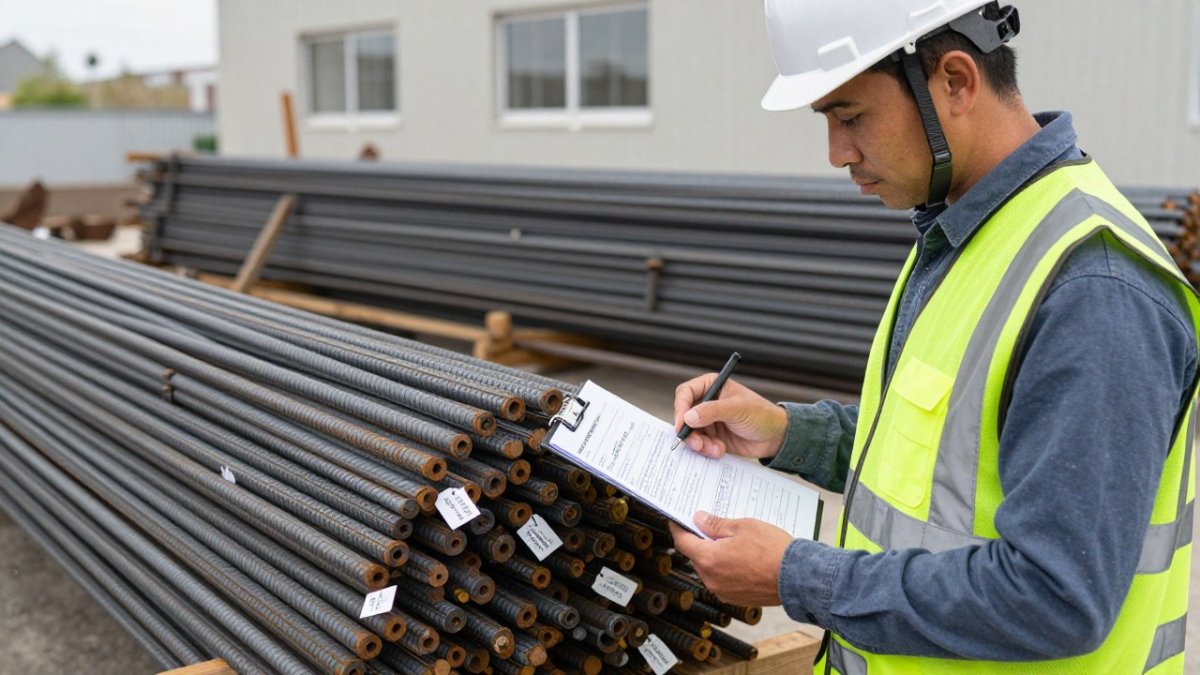
Run this checklist on every delivery:
- Delivery docket matches the order: grade, diameter, quantity, length
- Bundle tags match the docket and the mill certificate
- Bars are straight, with no excessive bending or kinks
Surface defects are the ones people wave through. Light surface rust is usually harmless.
A common mistake is accepting a partial delivery and promising to "sort the paperwork later". Later never comes, and you end up with steel in the structure that you cannot trace.
Steel Certificates and Compliance Documents: What to Ask For
Steel certificates are the paper trail proving what you bought is what was specified. Without them, you have steel of unknown origin in a structure that may one day be inspected, sold or repaired. The key is knowing how to verify these documents and tie them back to the bundles on site.
Ask for these documents with every structural steel order:
- Mill certificate or test certificate - the heat or batch number, grade, standard, and mechanical properties including yield, tensile and elongation.
- Certificate of compliance or conformity - a statement that the product meets the specified standard, issued by the mill or an accredited body.
- Traceability records - the link between the certificate and the bundles delivered, usually via heat number and bundle tag.
Verifying Traceability in Practice
The batch or heat number is the key. A certificate without a heat number that matches your bundle tags proves nothing. Run this sequence on every delivery:
- Read the bundle tag and record the heat number and grade.
- Find the matching heat number on the mill certificate.
- Check the grade and standard on the certificate against the engineer's specification.
- Confirm the mechanical properties meet the specified minimums.
- File the certificate against the delivery docket and the project records.
If any step fails, quarantine the steel rather than unloading it into the rack. A traceability gap found at the gate is a paperwork problem; the same gap found during an inspection is a structural problem.
Conformity Documentation and Standards
The compliance framework for building work is set out in the applicable building code, and the referenced standards are what your engineer will name in the specification. The certificate should cite that standard, not a generic claim of quality. Where a certification scheme covers the product, ask for the certificate number and confirm it is current and covers the product and grade you received.
Ask for these documents with every structural steel order and check each one against the delivery.
| Document | What it proves | Key detail to check |
|---|---|---|
| Mill or test certificate | Grade, standard and mechanical properties | Heat or batch number, yield, tensile, elongation |
| Certificate of compliance or conformity | Product meets the specified standard | Issued by mill or accredited body |
| Traceability records | Link between certificate and bundles delivered | Heat number and bundle tag |
| Test results where required | Batch performance against the specification | Tensile, yield, impact or chemical results |
| Coating or galvanising certificates | Protection meets the specification | Coating thickness and adhesion |
Corrosion, Exposure and Whole-Life Cost: Protecting Your Quality Steel
Corrosion resistance decides how long your steel lasts, and exposure decides how much resistance you need.
The protection options, from simplest to most involved:
- Correct grade selection - stainless steel or a suitable coated product for severe exposure.
- Galvanising or coating - a barrier between the steel and the environment.
- Sealants and detailing - keeping water out of joints and connections.
- Stainless fixings in exposed areas - so the fixing outlasts the member.
For durable detailing on exposed work, a construction-grade sealant or adhesive helps keep moisture out of connections. You can see construction-grade sealant for durable detailing in our range. For securing in exposed conditions, 316 stainless steel cable ties are a durable fixing option that will not rust out like mild steel.
Whole-life cost is a sound basis for specification decisions. A cheaper steel that corrodes in a few years costs more than a better-protected one over the life of the building.
Watch out: mixing stainless and mild steel fixings in a wet or coastal environment can drive galvanic corrosion. Match the fixing to the exposure, not to the price list.
Ordering Quality Steel for Your Next Project from Trade Warehouse Direct
Ordering quality steel comes down to three things: a clear specification, verified certificates and a supplier who can deliver the right product on time.
Trade Warehouse Direct supplies trade-quality building supplies with online ordering. Our features that matter here:
- Price Match Guarantee - see the website for current terms.
- Nationwide delivery - with free standard shipping over $150.
- Warehouses in VIC and WA.
If you are at the ordering stage and need structural anchors, you can buy 304 stainless steel wedge anchors in a box of 100 in a range of sizes.
Getting steel right is not about finding the cheapest bundle. It is about matching grade, diameter and protection to the engineer's design, then proving it with certificates.
Frequently Asked Questions
How do you choose the right steel for a construction project?
Start with the structural engineer's specification, which sets the grade, section size and bar diameter for each element. Match the steel grade to the loads and exposure conditions, then confirm the supplier can provide certificates and traceability documentation. Choose quality steel by checking grade markings, mill certificates and surface condition on delivery, and never substitute a lower grade without written sign-off from the engineer.
What is the difference between mild steel and high-strength steel?
Mild steel has a lower yield strength and is more ductile and easier to weld and bend. High-strength steel, such as Fe 500 or Fe 550, carries more load for the same bar diameter, which lets you use smaller sections or fewer bars. The trade-off is less ductility and tighter welding requirements, so the choice depends on the design and the engineer's specification rather than cost alone.
What documents should you check when buying construction steel?
Ask for a mill test certificate showing chemical composition and mechanical properties, a certificate of compliance confirming the steel meets the specified standard, and delivery documentation that matches the heat numbers on the bars. Check that the grade on the certificate matches what you ordered and that the heat numbers trace back to the bundle. Keep copies on file for the project records and any later inspection.
How can you check the quality of construction steel on delivery?
Inspect for surface defects such as cracks, seams, heavy rust or pitting, and check that grade markings and tags match the docket. Measure bar diameter and section size against the specification, and confirm heat numbers on the bars match the mill certificates. If anything looks wrong, quarantine the bundle and request replacement documentation before it goes into the structure.


