

Last Updated: 25 October 2026
Quick Summary
You can buy bulk electrical supplies for solar installers from trade suppliers such as Trade Warehouse Direct, which offers a Price Match Guarantee, nationwide delivery, warehouses in VIC and WA, and free standard shipping over $150. Start with the power path and protection categories, since those are the lines you cannot afford to run short on.
- Split your stock list into power path, protection, structural and consumable groups with separate reorder rules.
- Keep two or three DC cable sizes your jobs actually use rather than a broad spread.
- Buy connectors from one brand family and never mix connector types across a system.
- Check Australian certification, local warranty support and monitoring compatibility before committing to wholesale inverter orders.
- Get delivery cost quoted for your address before comparing supplier bottom lines.
Table of Contents
- What Bulk Electrical Supplies Do Solar Installers Actually Need?
- Solar Electrical Components: Building a Stock List That Covers Every Job
- Solar Cables and Connectors: The Items You Should Never Run Out Of
- Buying Solar Inverters Wholesale: What to Check Before You Commit
- Solar Installation Supplies: The Small Parts That Hold a Job Together
- How to Compare Bulk Electrical Supplies Without Getting Caught Out
- Placing Your First Bulk Electrical Supplies Order
- Frequently Asked Questions
What Bulk Electrical Supplies Do Solar Installers Actually Need?
Bulk electrical supplies for solar installers are the trade quantities of cable, connectors, isolators, enclosures, fixings and mounting hardware that keep installation crews moving from job to job. A common pattern on stock lists is that big-ticket items get planned, and small parts cause delays. A crew can have panels and an inverter on site and still lose a day because nobody packed the right MC4 connectors or a spare DC isolator.
The Australian solar sector runs on tight install schedules and strict compliance. The Clean Energy Council's installer accreditation guidance sets out the standards accredited installers work to, and the Australian Standards for grid-connected PV systems define what components a compliant installation needs. Those requirements, not guesswork, should shape what you keep in bulk.
Below, we break down the stock categories that matter, what to check before committing to wholesale inverter orders, and how to compare suppliers without getting caught out on quality or delivery.
Solar Electrical Components: Building a Stock List That Covers Every Job
A workable stock list starts with the components that appear on nearly every job. Solar electrical components fall into three rough groups: power path items, protection items and structural items. Power path covers DC cable, connectors and junction hardware. Protection covers isolators, breakers, surge devices and enclosures. Structural covers rails, clamps, brackets and roof fixings. Mastering the selection of these essential electrical components provides a reliable foundation for scaling your installations from residential rooftops to smaller mobile projects.
| Category | Typical Items | Reorder Signal |
|---|---|---|
| Power path | DC cable, MC4 connectors, junction boxes | Below two jobs' worth |
| Protection | DC isolators, breakers, surge protection | Below one job's worth |
| Structural | Rails, mid-clamps, end-clamps, roof hooks | Below one job's worth |
| Consumables | Cable ties, labels, tape, sealant | Last box opened |
A common mistake is treating all four groups the same. Power path and protection items are safety-critical, so running out mid-job is not an option. Consumables can be topped up on a weekly cycle. Split your stock list along those lines and the reorder rules write themselves.
Solar Cables and Connectors: The Items You Should Never Run Out Of
If one category deserves a permanent buffer, it is solar cables and connectors. A single missing connector pair can stall a crew for hours, and mismatched connectors are worse than none at all. DC cable sizing depends on run length and current, so keep the two or three sizes your jobs actually use rather than a broad spread of one reel each.
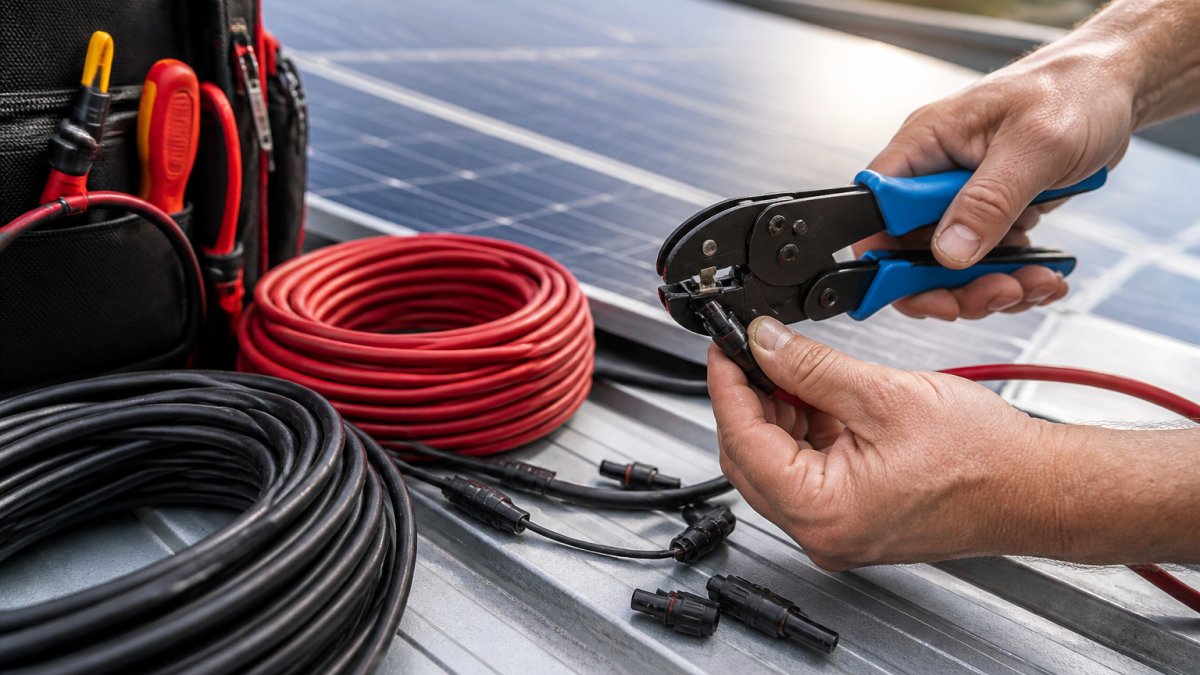
Connectors need the same discipline. Buy from one brand family and stay with it, because mixing connector types across a system creates a compatibility problem you will have to explain later. Keep a crimping tool and a stock of spare pins in every vehicle.
Watch out: UV degradation is the quiet killer of cheap DC cable. Cable that passes on day one can fail inspection a few years later if the insulation is not rated for continuous outdoor exposure. Check the rating before you buy in volume, not after.
Buying Solar Inverters Wholesale: What to Check Before You Commit
Wholesale inverter buying is where the biggest money sits, so it deserves the most caution. Three checks matter before you commit to a pallet: Australian certification, warranty support based locally, and firmware and monitoring compatibility with the systems you already install.
- Certification: confirm the model is approved for connection to the grid in the states you work in.
- Warranty pathway: ask who handles a claim and where the replacement ships from. A warranty that routes offshore adds weeks to a customer dispute.
- Monitoring: check the platform works with your existing fleet dashboard.
A common mistake is buying on unit price alone. The real cost of a wholesale inverter is unit price plus the cost of a warranty claim you have to manage on your own time. Ask for the claim process in writing before the first order.
Solar Installation Supplies: The Small Parts That Hold a Job Together
The small parts decide whether a job finishes on schedule. Solar installation supplies cover cable glands, breather vents, mounting feet, earthing hardware, labels and signage, and the fixings that hold rails to roofs. None of these cost much individually, and all of them can stop a job dead.
We group these into a "job kit" approach: a fixed list of small parts packed per installation, replenished after each job rather than counted item by item. It sounds basic. In practice, it is the difference between a crew that leaves the yard complete and one that makes a hardware run at 7 am.
Keep earthing and labelling stock separate and never let it drop below a full job's worth. These are compliance items, and an installation without them does not pass.
How to Compare Bulk Electrical Supplies Without Getting Caught Out
Comparing bulk electrical supplies comes down to four questions: is the stock genuinely available, is the quality verifiable, is the delivery cost predictable, and is the pricing consistent across orders. Before you commit to a supplier, it is worth knowing how to get bulk pricing for contractors. Most suppliers look similar on a quote sheet. If you are weighing up a major competitor, this Buildingsupplies.com.au alternative for trade pros explains how the two compare. They diverge on the answers to those four.
Start with availability. A price list means nothing if the item ships in six weeks. Ask for current stock levels on the specific lines you need, not a general assurance. Then verify quality: request datasheets and certification for safety-critical items, and check that the batch you receive matches what was quoted. A seven-step check for building material quality gives you a practical method for confirming that what you are comparing is genuinely good.
Delivery is the hidden line item. For bulky orders, freight can swing the total cost enough to erase a unit-price advantage, so get delivery quoted before you compare bottom lines.
Placing Your First Bulk Electrical Supplies Order
Your first bulk order should be small enough to test the supplier and large enough to matter. If you want a step-by-step guide to sourcing bulk building supplies, it walks you through placing a first order without missing anything. We suggest starting with the power path and protection categories, since those are the lines you cannot afford to run short on, and adding structural items once you have seen how the first delivery lands.
- Confirm the exact item list against your last five jobs
- Request current stock levels and lead times per line
- Get delivery cost quoted for your address before ordering
- Check certification and datasheets for safety-critical items
- Set a reorder trigger for each category
Trade Warehouse Direct offers a Price Match Guarantee, nationwide delivery, warehouses in VIC and WA, and free standard shipping over $150, so you can test a first order without carrying the freight cost yourself.
Frequently Asked Questions
What electrical supplies do solar installers need for an installation?
A typical job needs solar cables and connectors, isolators, DC and AC breakers, mounting hardware, cable management and fixings. Most installers also carry spare connectors, fuses and labelling supplies so a missing part does not stall the job. Keep a core stock list covering the systems you install most often, then top up job-specific items per project. Ordering bulk electrical supplies against that core list reduces trips to the wholesaler and keeps crews moving.
What should installers check before buying wholesale solar components?
Check that components are rated for the system voltage and current you work with, that cables carry the correct markings, and that connectors match the cable type. Confirm the supplier holds stock locally rather than drop-shipping, ask about delivery times to your area, and check the returns process for faulty items. For solar inverters wholesale, confirm warranty terms and whether the supplier supports Australian warranty claims.
What Australian standards apply to solar electrical components?
Solar installations in Australia must comply with AS/NZS 5033 for photovoltaic array installation and safety, and electrical work must follow AS/NZS 3000, the Wiring Rules. Connectors and cables should carry the certifications their standard requires, and installations need to meet the requirements set by the Clean Energy Council for accredited installers. Check that any component you buy holds the certification its intended use demands before you fit it.
How can installers compare bulk pricing with smaller orders?
Work out your cost per unit at each quantity tier, including freight, rather than comparing headline prices. Factor in how often you use each item, because bulk pricing only saves money on parts you turn over quickly. Ask suppliers about account terms and delivery costs to regional areas, since freight can wipe out a volume discount. Request a quote for your regular order and compare the total landed cost, not the shelf price.
Stockouts cost more than stock does. If your crew is tired of chasing connectors and isolators between jobs, Trade Warehouse Direct gives you one place to order trade-quality electrical and building supplies in bulk, with a Price Match Guarantee, nationwide delivery and free standard shipping over $150. Get started with Trade Warehouse Direct and keep every job moving.

