
Last Updated: 4 November 2026
Quick Summary
Sourcing fire safety equipment for contractors means buying extinguishers, fire points, temporary alarms, signage and fire-retardant PPE against a written specification, not a single bulk order. Match extinguisher types to the hazards on site, confirm lead times and compliance documentation with your supplier, and order against a staged schedule.
- Class ABE dry chemical extinguishers cover the widest range of construction site hazards.
- Order in three passes: base requirement, rotation allowance and replenishment buffer.
- Under AS 1851, servicing follows set intervals and records must be kept.
- Ask suppliers for a sample certificate of compliance before you commit to an order.
- Compare quotes on total cost of ownership, not unit price alone.
Table of Contents
- Fire Safety Equipment for Construction Sites: What You Actually Need
- Choosing a Fire Extinguisher Supplier for Contractors
- Bulk Fire Extinguisher Supply: Getting Quantities and Lead Times Right
- Fire Safety Equipment Inspection and Maintenance Duties
- Comparing Supplier Quotes and Total Cost of Ownership
- Certification, Traceability and Compliance Evidence
- Building Your Procurement Checklist Before You Order
- Frequently Asked Questions
Fire Safety Equipment for Construction Sites: What You Actually Need
Fire safety equipment for construction sites is the combination of extinguishers, alarms, signage, fire points and protective gear that keeps a partially built structure defensible before permanent systems go in.
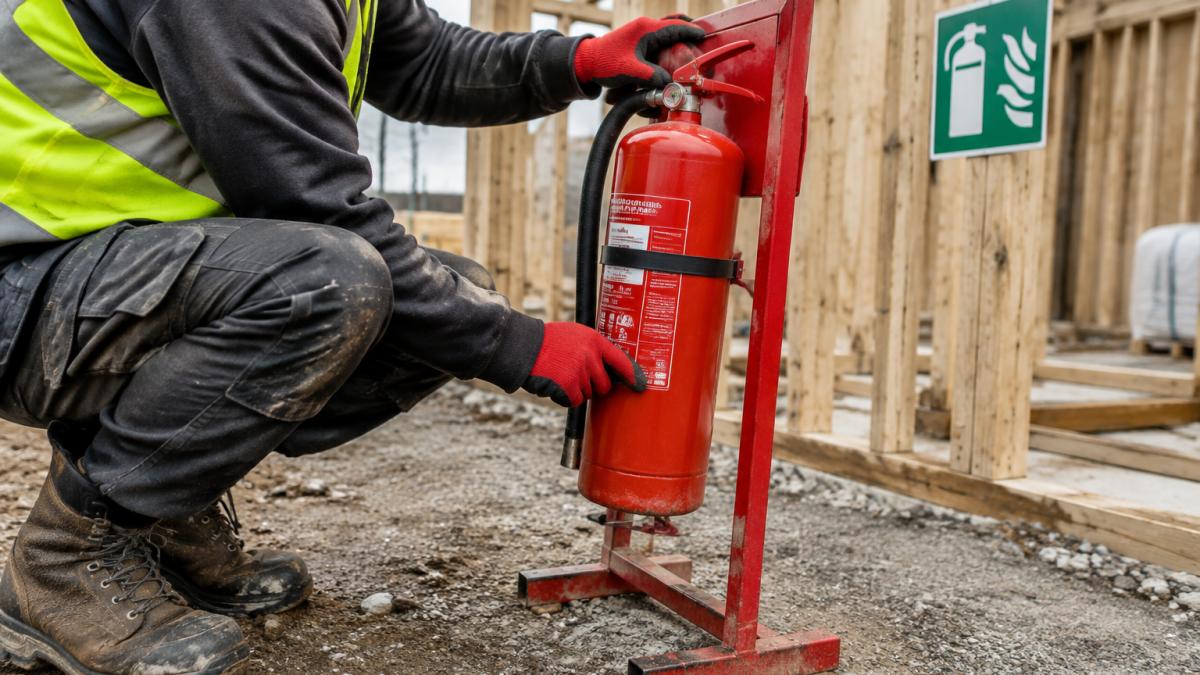
The core kit on a live site usually comes down to six items:
- Portable extinguishers at every active work area
- A fire point or trolley that keeps gear together and visible
- Temporary alarms or air horns where detection is not yet installed
- Safety signs marking exits, assembly points and equipment locations
- Fire blankets near hot works and site sheds
- Fire-retardant PPE for anyone welding, grinding or cutting
What most guides miss is that quantities follow the work, not the floor area. A fit-out crew rotating across three levels needs extinguishers where the hot work happens, not evenly spread to satisfy a drawing.
Matching Extinguishers to the Hazards on Site
Extinguisher selection starts with the fuel, not the size of the site. Ordinary combustibles such as timber, cardboard and packaging call for water or foam. Flammable liquids, solvents and fuels call for foam or dry chemical.
Class ABE dry chemical units cover the widest range on a construction site, which is why they dominate temporary installations. The mistake is assuming one type covers everything. Water on an electrical or fuel fire makes the situation worse, not better.
Pair extinguisher selection with fire-retardant PPE for hot works. The Pro Choice Inferno Safety Goggles with fire retardant frame and smoke lens suit grinding and welding tasks where sparks and smoke are constant, and they sit naturally alongside the extinguishers rather than replacing them.
Fire Points, Trolleys, Alarms and Safety Signs
A fire point is a marked, accessible location holding an extinguisher, a blanket and a sign showing what is there. On a construction site, fire points need to move as the build progresses, which is why trolleys earn their place.
Temporary alarms matter more than most contractors admit. Before detection systems are commissioned, air horns or battery-powered smoke alarms give crews warning in a site shed or enclosed level. Safety signs complete the picture: exit routes, assembly points, extinguisher locations and no-smoking notices all need to be visible from a distance in poor light.
Choosing a Fire Extinguisher Supplier for Contractors
A suitable fire extinguisher supplier for contractors should behave like a trade supplier rather than a retail shop. You want stock on hand, clear lead times, and someone who understands that a site cannot wait a fortnight for a refill.
Four things separate a workable supplier from a frustrating one:
- Local stock and stated lead times. Gear held in a warehouse you can reach beats a special order every time. Ask for a written lead time per product line, not a general promise. A supplier who cannot state a lead time in days is telling you something.
- Trade quantities and staged supply. A supplier set up for single-unit retail sales will struggle when you need twenty units across three sites. Confirm they can hold buffer stock and release it against a delivery schedule rather than forcing one bulk shipment.
- Documentation at delivery. Certificates and compliance evidence should arrive with the goods, not three weeks later after you chase them. Specify in the purchase order exactly what must accompany each unit: manufacturer certification, batch or serial traceability, and service tags where applicable.
- Servicing and replacement access. A supplier who also services or can put you in touch with a competent servicing provider shortens the loop when a unit is discharged or damaged. Ask who services their products in your region and how quickly they can attend.
Trade Warehouse Direct operates warehouses in Victoria and Western Australia and delivers nationwide, which shortens the gap between ordering and having extinguishers on the wall. You can browse the site safety product range to see what is actually available before you commit to a purchase order.
Verifying a supplier before you commit
A short verification pass before the first order saves months of chasing. Ask each shortlisted supplier for:
- A sample certificate of compliance and a sample service tag so you can see the format you will receive
- Confirmation of which Australian Standards the products are certified against, and whether certification is current
- A named contact for documentation queries, not a generic inbox
- A written statement of lead times by product category and destination
- Their process for handling damaged or non-compliant units on delivery
Watch out: a supplier who cannot produce a sample certificate before the sale is unlikely to produce one reliably after it, and missing documentation is far harder to fix once the equipment is on site and in use.
Matching supplier capability to project type
A single-site fit-out and a multi-stage construction project place different demands on a supplier. For a single site, local stock and fast delivery matter most.
Bulk Fire Extinguisher Supply: Getting Quantities and Lead Times Right
Bulk fire extinguisher supply works best when you order against a schedule rather than a single delivery. A staged build needs extinguishers on level one before level four exists, so ordering everything at once often means storing half of it in a container for months.
Work out quantities in three passes:
-
Base requirement: one extinguisher per active work area, plus spares
-
Rotation allowance: units that travel with crews between zones
-
Replenishment buffer: replacements for discharged or damaged units
If you are buying in trade volumes, it is worth reading up on how to get bulk pricing for trade maintenance contractors before you request a large order, because the way you structure the request affects what comes back.
Ordering the full project quantity in one hit can tie up capital and leave extinguishers sitting unserviced in storage, which creates its own compliance problem.
Fire Safety Equipment Inspection and Maintenance Duties
Fire safety equipment inspection and maintenance is a legal duty, not a nice-to-have. Under AS 1851, routine servicing of fire protection equipment follows set intervals, and records must be kept.
Routine visual checks versus scheduled servicing
These are two different obligations and conflating them is a common mistake. Routine visual checks are the frequent, simple inspections site staff can carry out: pressure gauge, pin and seal, corrosion, signage, hose condition. Scheduled servicing is the periodic, more thorough work carried out by a competent person against the applicable standard, and it is the servicing record, not the visual check, that a certifier or surveyor will usually ask to see.
A simple monthly check covers:
- Pressure gauge in the green zone
- Safety pin and tamper seal intact
- No corrosion, dents or blocked nozzles
- Signage legible and in place
- Hose and nozzle free of cracks
- Unit mounted securely and accessible
- Service tag present and within its interval
Who is competent to service
A visual check by a trained site worker is not the same as scheduled servicing by a competent person.
Record-keeping that survives handover
Keep a log for every unit, noting the date, the check, who did it and what was found. When a surveyor or certifier asks for evidence, that log is what you produce.
Maintenance duties when equipment moves
Construction equipment is not static. Extinguishers travel with crews, fire points relocate as the build progresses, and units are swapped out when discharged or damaged.
Comparing Supplier Quotes and Total Cost of Ownership
The cheapest quote is rarely the cheapest outcome. Total cost of ownership adds delivery, servicing access, replacement parts and the cost of a delay when stock does not arrive.
Build a comparison across four columns:
| Cost line | What to include | Why it matters |
|---|---|---|
| Unit price | Extinguisher, bracket, sign | Baseline only |
| Delivery | Freight to each site | Regional deliveries vary widely |
| Servicing | Who services, how far they travel | Remote sites pay more |
| Downtime risk | Lead time and stock reliability | A late delivery stalls handover |
If you are weighing an online purchase against a traditional merchant, it helps to understand whether buying building materials online is actually cheaper once freight and lead times are factored in. Pricing depends on quantity, product type and delivery distance, so ask for a written quote rather than working from list prices.
Certification, Traceability and Compliance Evidence
Every extinguisher you install should carry a current compliance plate, a service record and a traceable batch. Ask for the certificate of compliance with the delivery, not after.
What to keep on file:
- Manufacturer certification for each unit
- Service tags showing date and technician
- Purchase records linking units to a site
- Close-out documentation for handover
This matters most on multi-site or staged work, where equipment moves between locations and records can go missing. A unit without a paper trail is a liability during an audit, even if it works perfectly.
Building Your Procurement Checklist Before You Order
A procurement checklist turns a vague request into a specification a supplier can quote against. Use this before you send anything out.
Specification template:
- Project name and site address
- Hazard types present (combustibles, flammable liquids, gas, metals)
- Extinguisher types and quantities by area
- Fire point and trolley locations
- Signage required
- PPE requirements for hot works
- Delivery dates by stage
- Compliance documentation required
Sourcing workflow:
- Walk the site and map hazards against work stages
- Match extinguisher types to each hazard
- Set quantities per active area, plus rotation and buffer
- Write the specification using the template above
- Request quotes from suppliers with local stock
- Compare on total cost, not unit price
- Confirm lead times against your build programme
- Check certificates on delivery and log every unit
Run this once and you have a repeatable process for every project that follows. The contractors who get sourcing right are the ones who treat it as a checklist, not a phone call.
Frequently Asked Questions
What fire safety equipment is needed on a construction site?
Most sites need extinguishers matched to the hazards present, fire points with signage, a means of raising the alarm, and often fire trolleys or hose reel coverage on larger projects. Ordinary combustibles call for water or foam, flammable liquids for foam or dry chemical, and gas or metal hazards for specialised agents. Quantities depend on site size and layout, so check your project's fire safety plan and essential fire safety measures schedule before ordering.
How often should fire extinguishers be inspected and serviced?
Extinguishers need a monthly visual check by site staff, covering pressure gauge readings, seals, damage and accessibility. Formal servicing should follow the applicable Australian Standard and the manufacturer's requirements, so check current intervals with a competent servicing provider. Keep records of every inspection and service, because auditors and principal contractors will ask for them, and missed servicing is one of the most common compliance gaps found on active sites.
How do you check whether fire safety equipment meets Australian requirements?
Ask for the product's Standards mark and certification documentation, and confirm the extinguisher is rated to the relevant Australian Standard for its type. Check the supplier can provide test certificates, batch traceability and servicing records where applicable. Equipment that arrives without paperwork is hard to defend at audit, so build certification evidence into your procurement checklist before you place a bulk order.
What should contractors look for in a fire safety equipment supplier?
Look for local stock availability, clear lead times, delivery coverage for regional sites, and the ability to supply replacement units quickly when an extinguisher is discharged. A supplier who can also point you to inspection and maintenance support saves coordinating multiple vendors. Confirm pricing for bulk quantities up front, and ask how close-out documentation is handled for staged projects.
Fire safety sourcing gets messy when stock, documentation and lead times all pull in different directions. Trade Warehouse Direct simplifies that by holding site safety stock across warehouses in Victoria and Western Australia, delivering nationwide, and offering free standard shipping on orders over $150, backed by a Price Match Guarantee. Get started with Trade Warehouse Direct and kit out your next site without chasing three suppliers for one delivery.

