

Last Updated: November 18, 2026
Quick Summary
Concrete cure time is the period needed for the mix to reach its designed strength, and for most work this is about 28 days. The surface often feels hard within 24 to 48 hours, but strength keeps building for weeks. Light foot traffic can usually come after a day or two, while light vehicles generally wait around seven days.
- Surface drying often takes 24 to 48 hours, but this does not mean the concrete is strong.
- Most concrete reaches its designed strength at about 28 days.
- Light vehicles usually need to wait around seven days before driving on a slab.
- Keep the surface moist for at least seven days, using misting or damp covers.
- Cold below about 5°C slows curing, and hot or windy weather can dry the surface too fast.
Table of Contents
- How Long Does Concrete Take to Dry Versus Cure?
- Concrete Curing Timeline by Project Type
- How Long Before You Can Walk on Concrete
- How Long Before You Can Drive on Concrete
- How to Cure Concrete Step by Step
- How Weather and Mix Change Curing Time
- Planning Your Next Concrete Project Around the Curing Window
- Frequently Asked Questions
How Long Does Concrete Take to Dry Versus Cure?
Concrete cure time is the period it takes for the mix to reach its designed strength, and it is much longer than most people expect. Drying and curing are not the same thing. Drying is the loss of surface moisture, which can happen in a day. Curing is the chemical reaction between cement and water that gives concrete its hardness, and it keeps going for weeks. Because curing depends on keeping the right balance of moisture and conditions as the concrete gains strength, it helps to manage concrete setting time without mistaking a dry surface for fully cured concrete.
Concrete jobs often need fixings, protection and site supplies, and these curing questions come up often among builders and DIYers. A common mistake is treating a firm surface as a finished slab.
Here is the short version:
- Drying: surface feels hard, often within 24 to 48 hours
- Initial set: concrete stops being workable, usually within a few hours
- Curing: strength builds over days and weeks
- Full design strength: generally benchmarked at 28 days
Concrete does not dry out to get strong. It gains strength while it stays moist. Cutting off moisture too early can weaken the slab.
Watch out: a slab that looks solid on day two can still be far from its design strength. Treat the surface as a sign of early progress, not a finish line.
Concrete Curing Timeline by Project Type
Cure time depends on what you are building. Thicker, structural pours need longer, and small repairs can be ready sooner. The table below separates the three milestones that matter: when you can walk on it, when light vehicles can use it, and when it reaches full design strength. Use these as a planning guide rather than a rule, and always follow the supplier's or engineer's specification for structural work. For nib walls and insulated slab edges, see Thermasheet nib wall products.
| Project type | Walk on it | Light vehicles | Full strength |
|---|---|---|---|
| Small repairs and patches | 24 hours | Not recommended | About 28 days |
| Garden paths and steps | 24 to 48 hours | Not recommended | About 28 days |
| Slabs and driveways | 2 to 3 days | About 7 days | About 28 days |
| Structural pours | 3 to 7 days | Follow engineer's advice | About 28 days |
Slabs, Driveways and Structural Pours
Driveways and structural slabs carry real loads, so they need the most care. Most people can walk on a standard slab after a couple of days. Vehicles should wait until the concrete has gained enough strength, which is commonly around seven days for light cars and longer for heavier loads. Structural work should follow the specification from your engineer or builder. If the design calls for a set strength, do not rely on the calendar alone.
Small Repairs and Garden Work
Patches, steps and garden edging usually set quickly and can take light foot traffic within a day or two. They still need curing, though. A small pour left to dry in hot sun can crack or lose strength just like a big slab.
How to Assess Readiness Safely
Surface dryness and simple checks have limits. A fingernail or tool-edge test in an inconspicuous corner can tell you whether the surface has hardened enough for light walking, but it says nothing about strength under load. For vehicles, heavy tools or structural use, the reliable route is a professional strength test or your engineer's advice. A slab can feel hard on day two and still be well short of its design strength, so treat appearance as early progress, not a finish line.
Watch out: loading a slab before it has gained enough strength can cause surface chipping, spalling and permanent indentations that cannot be fixed by waiting longer.
How Long Before You Can Walk on Concrete
For most residential slabs, you can usually walk on the surface after 24 to 48 hours, provided it is hard to the touch and not marked by footprints. Light foot traffic is generally fine at that point. Heavy tools, scaffolding and stacked materials should wait.
A simple test: press a fingernail or the edge of a tool into an inconspicuous corner. If it leaves no mark, the surface has hardened enough for light walking.
The early days matter more than people often expect. Protect the surface from rain, dragging loads and sudden temperature swings.
How Long Before You Can Drive on Concrete
Driving on new concrete is where most damage happens. Light vehicles usually need to wait around seven days, and heavier trucks and machinery should wait longer. Always confirm with the concrete supplier or your engineer for loaded vehicles.
Early driving can cause surface chipping, spalling and permanent indentations. These problems cannot be fixed by waiting longer. Keep vehicles off until the timeline is clearly met.
How to Cure Concrete Step by Step
Good curing is mostly about keeping the surface moist and at a stable temperature for the first week. Follow these steps:
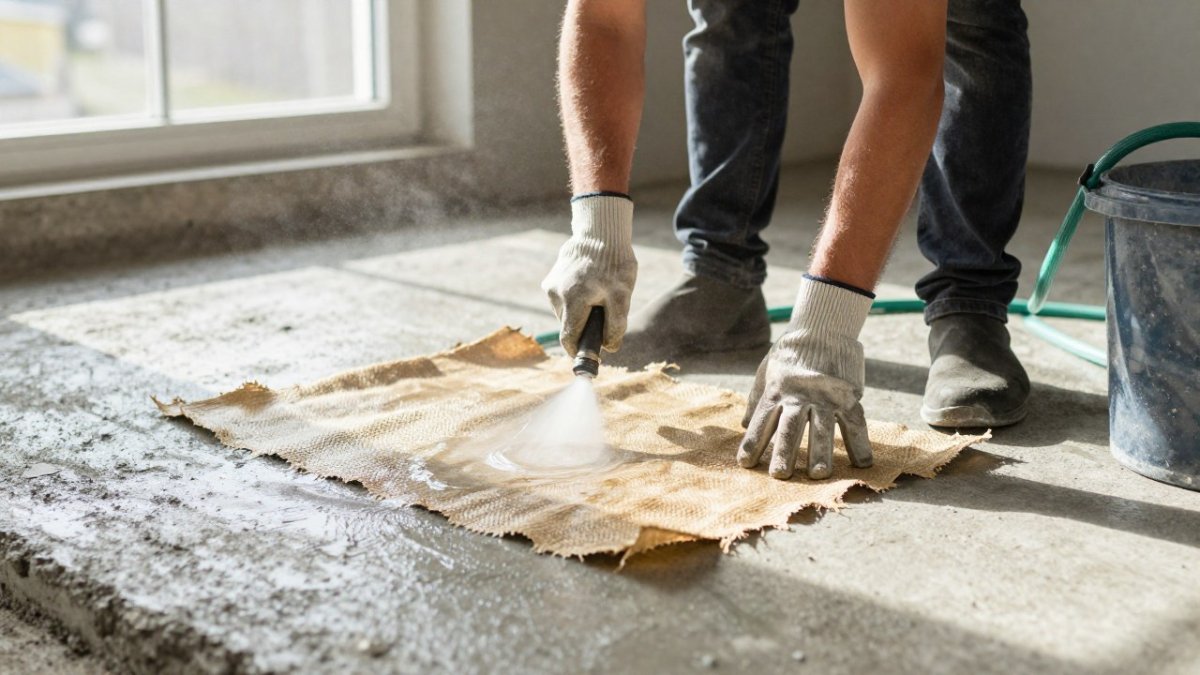
- Start early. Begin curing as soon as the surface can be worked without marking, often within a few hours of finishing.
- Keep it damp. Mist the surface lightly or cover it with damp hessian or plastic sheeting.
- Avoid pooling water. Standing water can damage the finish, so mist rather than flood.
- Protect from sun and wind. Shade fresh work and cover it on hot or windy days.
- Maintain for at least seven days. Keep the surface moist for the first week where possible.
- Keep traffic off. Restrict foot, tool and vehicle traffic until the timeline is met.
- Check before loading. Test the surface before putting weight on it.
!A tradesperson in work gloves misting and covering a freshly finished concrete slab with damp hessian on a sunny morning
Stopping curing after two or three days, just because the surface looks finished, is a mistake. Keep the process going for the full period.
How Weather and Mix Change Curing Time
Weather is one of the biggest variables in how long concrete takes to cure, because the cement-water reaction needs both moisture and a workable temperature. Cold slows the reaction, while hot, dry or windy conditions pull moisture out of the surface faster than the concrete can use it. Rain is a separate problem: it can wash the surface or dilute the finish if it lands before the concrete has set.
Seasonal guidance for British conditions:
- Hot summer days: shade the slab, mist often, and avoid pouring in the middle of the day. Surface crusting and plastic shrinkage cracks are the main risks.
- Cold winter mornings: the reaction slows sharply below about 5°C, and frost can damage fresh concrete. Expect slower strength gain and extend the timeline; do not pour onto frozen ground or allow fresh concrete to freeze.
- Wet weather: cover fresh work and make sure the surface is not left exposed. Persistent rain can raise the water-cement ratio at the surface and weaken the top layer.
- Windy sites: protect the surface, as wind accelerates evaporation and can dry the surface before it has gained strength.
The mix also matters. A stronger mix or one with additives can change set and cure times, and a wetter mix can lose strength if it dries out. Cement type, admixtures, and slab thickness all shift the timeline, so always check the supplier's data sheet for the specific product you are using rather than relying on a generic calendar.
If concrete gets rained on before it has set, protect it with plastic and assess the surface once the rain stops. Light marking may be repairable, but heavy washout usually means the surface needs attention. Surface damage can appear within the first few hours; if the rain was brief and the surface is still sound, continue curing as normal.
Watch out: surface dryness is not a reliable sign of strength. A slab can look dry and still be far from its design strength, so do not use appearance alone to decide when to load it.
Planning Your Next Concrete Project Around the Curing Window
Build your schedule around the curing timeline rather than squeezing it in. Plan forms, load bearing and vehicle access so nothing rolls onto the slab too early. Order materials and protective supplies in advance so you are not rushing the curing stage.
Compare your project to the timelines above, then allow a margin for weather. A slab that needs seven days may need more in a cold week. Keep a simple log of when you poured, when you started curing and when you first walked or drove on it.
For more on preparing your build, see our guide on how to verify building material quality. If you are planning slab dimensions and volumes, our guide on how to calculate concrete volume for slabs walks through the numbers step by step.
Keep the first week in mind and the rest of the process becomes much easier to manage.
Frequently Asked Questions
How long does concrete take to cure fully? Most concrete reaches its designed strength at about 28 days. You can walk on it sooner, but full strength takes the full period.
Can I walk on concrete after one day? Often not safely. Most surfaces need 24 to 48 hours before light walking, and the surface should be hard and unmarked first.
Does hot weather make concrete cure faster? It can dry the surface faster, which may harm strength. Hot weather usually needs more misting and shade, not less care.
How long until I can park a car on a new slab? Light vehicles usually wait about seven days. Heavier loads need longer, so check with your supplier or engineer.
Frequently Asked Questions
How long does concrete take to cure fully?
Concrete reaches about 70 per cent of its design strength within seven days when it is kept moist and at a steady temperature, and it typically reaches its full rated strength at 28 days. Curing continues beyond that point but the gains are small. Cold weather slows the process considerably, while hot, windy conditions can dry the surface too quickly and weaken it. Keeping the slab damp for the first week is the single most effective thing you can do to reach full strength.
Is concrete fully cured after 28 days?
For most residential and light commercial work, 28 days is the benchmark for full design strength, and this is the figure engineers and suppliers normally quote. Concrete does not stop gaining strength at that point, but the increase is marginal. If the pour was done in cold weather or the surface was allowed to dry out early, the strength may still be below target at 28 days, so check the specification with your concrete supplier or engineer before loading the slab.
Does concrete take longer to cure in cold or wet weather?
Yes. Cold weather slows the chemical reaction between cement and water, so curing can take noticeably longer in winter, particularly during UK winters where overnight temperatures drop below 5 degrees Celsius. Wet weather is generally helpful because it keeps the surface moist, but heavy rain soon after finishing can wash cement from the surface and leave a weak layer. Protect fresh work with plastic sheeting or covers if rain is forecast.
Can rain damage freshly poured concrete?
Light rain on concrete that has been finished and has begun to set is unlikely to cause harm, but heavy rain falling before the surface has hardened can wash away cement paste, leaving exposed aggregate or a dusty, weak finish. Cover the slab with plastic sheeting as soon as you have finished it, and remove the covering once the surface is firm enough not to be marked. If the surface is damaged, it may need to be assessed before further work.

