

Quick Summary
LED mirrors are bathroom mirrors with light-emitting diodes built into the glass or frame, giving even light across the face and lower running costs than older fittings. Frontlit models suit shaving and makeup, while backlit models suit ambient lighting. Check the IP rating and have a licensed electrician confirm the installation.
- Frontlit mirrors direct light onto the face, making them better for shaving, makeup and skincare.
- Backlit mirrors give a soft halo of ambient light and work well as a feature piece.
- LED technology uses considerably less electricity and lasts far longer than halogen or incandescent fittings.
- Look for an IP rating suited to the bathroom zone and confirm it before buying.
- Have a licensed electrician check the wiring under AS/NZS 3000 before installation.
Table of Contents
- Why LED Mirrors Are Becoming the Standard Bathroom Choice
- Frontlit vs Backlit LED Mirrors: Which Lighting Style Suits You
- Backlit LED Mirrors and Ambient Bathroom Lighting
- LED Mirrors with Demister: Is the Pad Worth Paying For
- LED Mirror Size Guide: Choosing Dimensions and Mounting Height
- Electrical Safety, Installation and Care for LED Mirrors
- Choosing Your LED Mirror and Getting a Quote from Trade Warehouse Direct
- Frequently Asked Questions
Why LED Mirrors Are Becoming the Standard Bathroom Choice
Most Australian bathrooms still rely on a single overhead light that throws shadows across the face, which is why so many people now replace the plain mirror with an illuminated one.
LED mirrors are bathroom mirrors with light-emitting diodes built into the glass or the frame. Because the light comes from the mirror itself rather than the ceiling, it lands evenly on the face, reducing the harsh shadows that make shaving, makeup and skincare difficult.
Running costs are another reason for their growth. LED technology uses considerably less electricity than older halogen or incandescent fittings, and it lasts far longer before needing replacement. Exact savings depend on usage and the wattage of the model you choose, so check the product specifications before comparing options.
Frontlit vs Backlit LED Mirrors: Which Lighting Style Suits You
The two main lighting styles differ in where the light originates, and that difference shapes both how the mirror looks and how it performs. Choosing between them comes down to what you need the bathroom to do. Most retail pages list both styles without explaining the trade-off, so this section compares them on light direction, task suitability and appearance.
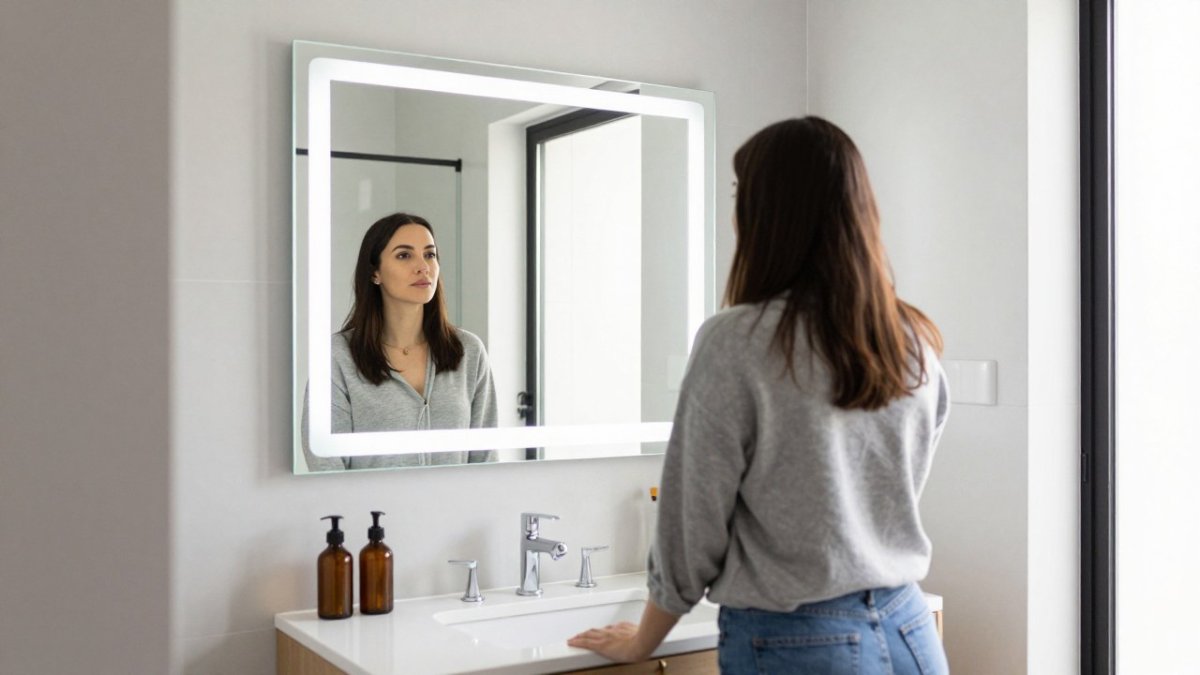
Frontlit LED mirrors: strengths and drawbacks
Frontlit mirrors place LEDs around the front edge of the glass, directing light towards the person standing in front of it. Because the light travels forward rather than sideways, it lands on the face and hands rather than on the wall behind, which is why frontlit designs are usually the better choice for shaving, makeup, skincare and contact-lens routines.
The trade-off is that the light is usually concentrated at the edges, so it can feel less even across a wide mirror, and the brightest band sits at the perimeter rather than the centre.
Backlit LED mirrors: strengths and drawbacks
Backlit mirrors have LEDs fixed behind the glass, creating a soft halo of light that spreads around the mirror's perimeter and washes the wall behind it. This gives a more ambient, spa-like effect and is often preferred for general bathroom lighting or where the mirror is a feature piece. The indirect light is gentler on the eyes at night and flatters the room rather than the face.
The drawback is that the light is indirect, so it may not be as strong for close detail work such as applying makeup or shaving precisely. Much of the output lands on the wall rather than on the person, and the centre of the glass can be dimmer than the edges.
How to choose between them
A practical way to decide is to start from the task. If the mirror is the main light you will use for grooming, frontlit is usually the safer choice because the light faces you.
Watch out: some products combine both, a frontlit strip plus a backlit halo, and the listing may describe them as 'dual lighting' or 'front and back lit'. Check the specification rather than the product name, because the same phrase is used loosely across ranges.
The table below sets out the main differences between the two lighting styles at a glance.
| Style | Light direction | Best for |
|---|---|---|
| Frontlit | Forward, onto the face and hands | Shaving, makeup, skincare |
| Backlit | Indirect halo onto the wall behind | General ambient lighting, feature mirrors |
| Frontlit, diffused | Softened by a diffuser | Avoiding glare at close range |
| Backlit, pale wall | Bounced back, more pronounced effect | Spa-like mood lighting |
Backlit LED Mirrors and Ambient Bathroom Lighting
Backlit mirrors work best as part of a layered lighting plan rather than as the only source of light in the room. A common approach is to pair a backlit mirror with a ceiling fitting or wall light for general illumination, reserving the mirror for task lighting at the basin. This keeps the room comfortable at night without the glare of a single bright source.
Dimming matters here. Mirrors with adjustable brightness let you lower the light for evening use and raise it for morning routines. Check whether dimming is built in or needs a separate controller, as this affects the final cost and installation.
LED Mirrors with Demister: Is the Pad Worth Paying For
A demister pad is a heated element fitted behind the mirror that stops condensation forming after a hot shower. Whether it is worth the extra cost depends on how often your bathroom fogs up and how much you value a clear mirror straight away.
For a household that showers daily in a small or poorly ventilated bathroom, a demister removes a frustration that otherwise means wiping the glass by hand. For a bathroom with an extractor fan that clears steam quickly, the benefit is smaller.
Consider the demister alongside the mirror size, because a pad must cover the area that fogs. Some products sell the mirror and demister separately, so confirm the pad dimensions match the glass before ordering.
LED Mirror Size Guide: Choosing Dimensions and Mounting Height
Size decisions affect both usefulness and appearance. A 524 x 524mm mirror suits a single vanity or a compact powder room, while a 524 x 1024mm model gives more height for full-length viewing or a taller vanity area. Measure the wall space and the basin before choosing, leaving a clear margin on each side.
Mounting height is equally important. A common guideline is to position the centre of the mirror at roughly eye level for the people who use the bathroom most. Where a household includes both tall and short users, a taller mirror or a mirror mounted slightly higher can accommodate both. Always confirm the mounting requirements in the product specifications, including the fixing method and the clearance needed for any wiring.
Electrical Safety, Installation and Care for LED Mirrors
Bathroom electrical work carries real risk, so the wiring and installation of an LED mirror should follow Australian requirements. Power and electrical installation in Australia are governed by AS/NZS 3000 (the Wiring Rules), and bathroom zones have specific rules on the placement of fittings. Check the current requirements with a licensed electrician before installation, and do not rely on this article as a substitute for professional advice.
Bathroom zones and what they mean for a mirror
The Wiring Rules divide a bathroom into zones based on distance from the bath, shower and basin, and each zone sets limits on what can be installed and how it must be protected. In practice, a mirror mounted above a basin usually sits in a zone where a fitting must be suitable for the location and protected by the appropriate residual current device (RCD). A mirror placed close to a shower or bath falls into a stricter zone, and some products simply cannot be installed there. The exact boundaries and requirements are technical and have been revised over time, so confirm the current zone diagram with your electrician rather than working from an old copy.
IP ratings and why they matter
Look for the IP (Ingress Protection) rating on the product specification. The first digit covers solids and the second covers water, so a higher second digit means better resistance to moisture. A mirror intended for a bathroom should carry a rating suited to its zone; a unit with no stated IP rating is a warning sign. The rating also affects where the mirror can legally be placed, so match the product to the zone before you buy rather than after.
Wiring, isolation and the electrician question
Low-voltage mirrors and pads with a transformer are often described as simpler to install, but the transformer still needs a suitable, accessible location and correct connection, and the mains supply feeding it is still mains voltage. Anything involving the fixed wiring, a new circuit, a spur from an existing circuit, or a connection behind the wall, should be handled by a licensed electrician.
Watch out: a mirror wired to a lighting circuit that is switched off at the wall is not necessarily isolated if the circuit has been wired incorrectly. Confirm with your electrician that the mirror can be fully isolated before any maintenance, and never work on the connections with the circuit live.
Positioning, clearance and ventilation
Leave clearance around the mirror for the frame, any visible light strip and the wiring entry point, and check the product specification for the minimum distance from the basin and from water outlets. Good ventilation reduces condensation and takes pressure off the demister, so run the extractor fan during and after showers. Where the mirror sits in a steamy corner, a demister pad and an IP-rated fitting are both worth confirming before purchase.
Care, cleaning and troubleshooting
For care, clean the glass with a soft cloth and a non-abrasive glass cleaner, keeping liquid away from the edges and any electrical connections. Do not spray cleaner directly onto the mirror; apply it to the cloth instead, so liquid cannot run into the frame or the wiring entry. If a light flickers or a demister stops heating, check the connections and the transformer first, then contact the supplier or a licensed electrician for repair advice. Persistent flicker can also point to a failing driver rather than the LEDs themselves, which is why the driver and transformer are worth checking before replacing the whole unit.
Choosing Your LED Mirror and Getting a Quote from Trade Warehouse Direct
Start by deciding on the lighting style, the size and whether you need a demister, then compare the specifications of the options that fit your wall space.
Visit Trade Warehouse Direct to browse the current range and request a quote for your project.
Frequently Asked Questions
What are the benefits of an LED bathroom mirror?
An LED bathroom mirror provides integrated, even lighting that reduces shadows on the face, which makes grooming, make-up and shaving easier than under a single overhead bulb. Because the lights are built into the glass frame, there is no separate fitting to clean or replace, and LEDs typically draw far less power than traditional halogen bulbs. Pricing depends on size, features and quantity, so check current prices and stock directly on the Trade Warehouse Direct website.
What is the difference between frontlit and backlit LED mirrors?
Frontlit LED mirrors place the light sources around the front edge of the mirror, directing light straight onto your face, which is generally preferred for make-up and shaving. Backlit LED mirrors place the light behind the glass, creating a halo effect that adds ambient glow to the room and can look more decorative. Many people choose frontlit models for task lighting and backlit models for feature lighting, and some ranges combine both. Compare the lighting style and specifications on each product page before you decide which suits your bathroom.
Do LED mirrors with a demister pad need to be wired in?
Yes. Most LED mirrors with a demister pad are hardwired to the bathroom's electrical circuit and must be installed by a licensed electrician in line with AS/NZS 3000 (the Wiring Rules). Installation near a bath or shower is subject to zone requirements, so the mirror's position and the power supply need to comply with those rules. Check the product's IP rating for wet-area suitability and confirm installation requirements before ordering.
How do you clean an LED mirror?
Switch the mirror off and let it cool before cleaning. Use a soft microfibre cloth lightly dampened with water or a mild, non-abrasive glass cleaner, and avoid spraying liquid directly onto the mirror edges or touch controls, as moisture can enter the housing. Avoid abrasive pads and harsh chemicals, which can damage the reflective backing and any protective coating. Check the manufacturer's care instructions for the specific model.


