

Table of Contents
- What You Need Before You Start Measuring
- Identify Your Existing Hinge Type
- How to Measure Cabinet Hinge Overlay
- Measuring a Concealed Cabinet Hinge Cup Size
- Checking Cabinet Hinge Screw Hole Spacing
- Troubleshooting Measurements That Do Not Match Standard Sizes
- Choosing Your Replacement Hinge With Confidence
- Frequently Asked Questions
Last Updated: November 21, 2026
Getting a replacement cabinet hinge right comes down to knowing how to measure replacement cabinet hinges accurately before you buy. Many DIY renovators order the wrong hinge because they measured only one thing. Get the cup size, overlay, screw spacing and opening angle right, and the new hinge will fit first time. This guide walks through each measurement in the order most people need them.
What You Need Before You Start Measuring
You only need a few basic tools, and most homes already have them. A steel tape measure is the most important. A small ruler or a set of callipers helps with the smaller numbers, such as hinge cup depth. A pencil and a notepad or your phone are useful for recording each measurement as you take it.
Take a clear photo of the old hinge from the front and the side before you remove anything, since this makes it easier to compare parts when you shop.
- Steel tape measure (5 metres is plenty)
- Ruler or callipers for small measurements
- Pencil and notepad, or your phone for notes
- Your phone camera for photos of the existing hinge
- Access to the cabinet door and frame
Work out whether you are replacing one hinge or the whole set. Most cabinets use two or more hinges per door, and every hinge should match.
Identify Your Existing Hinge Type
Start by working out what type of hinge you have. Most kitchen cabinets use a concealed hinge with a round cup that sits inside the door. Older cabinets sometimes use a visible butt hinge or a surface-mounted strap hinge.
A concealed hinge is hidden when the door is closed. You will see a round cup, usually about 35 millimetres across, drilled into the back of the door.
A visible hinge shows its knuckle or barrel when the door is shut. These are more common on older or decorative cabinets and are easier to identify by eye.
Watch out: Some hinges look alike but use different cup sizes. Do not assume a hinge is standard just because it looks similar to one on the shelf.
Before you measure, it helps to know which kind of hinge you have, since the figures you need depend on the type.
| Hinge type | How to spot it | What it looks like when closed |
|---|---|---|
| Concealed | Round cup drilled into the door | Hidden from view |
| Visible butt | Knuckle or barrel on the edge | Knuckle shows |
| Surface strap | Mounted on the outside of the frame | Strap visible on the face |
How to Measure Cabinet Hinge Overlay
Overlay describes how far the door sits over the cabinet frame when it is closed. Getting overlay wrong is the most common reason a replacement hinge does not fit, so measure it carefully and write the figure down before you shop.
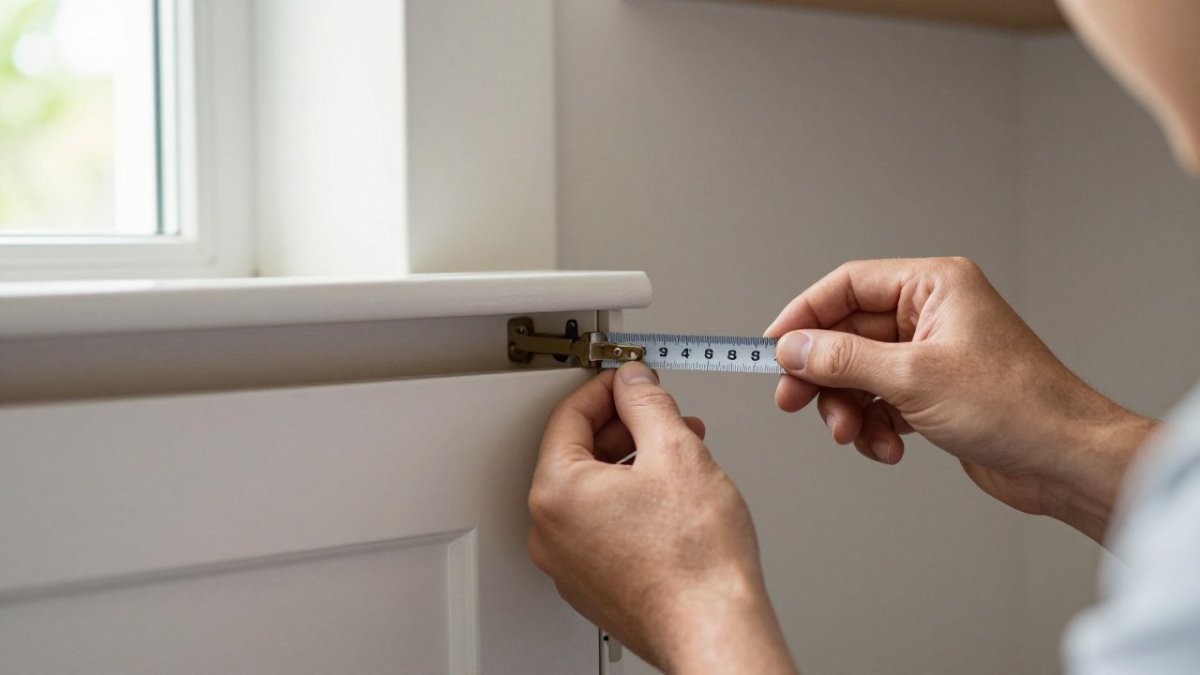
To measure it, close the door and measure the gap between the door edge and the frame edge. If the door covers the frame completely, you have a full overlay. If it covers about half the frame, that is a half overlay. If the door sits inside the frame opening with a small gap all round, that is an inset door.
You can measure overlay without removing the door. Close the door, then measure from the inside edge of the door to the frame. Write down the figure in millimetres.
Full, Half and Inset Overlay Explained
Full overlay means the door covers most of the frame, leaving only a thin gap between doors.
A simple way to tell them apart is to look at the gap between two closed doors. On a full overlay, the gap is usually only 2 to 3 millimetres. On a half overlay, the gap is wider because each door covers only half of the shared frame member, often 6 to 10 millimetres.
Worked examples help here. If your door edge sits 18 millimetres over the frame edge, that is a full overlay and you need a full overlay hinge.
Each overlay type needs a different hinge. A hinge built for full overlay will not sit correctly on an inset door, and the reverse is also true.
Measure the overlay in millimetres and keep the figure with your other notes. You will compare it against the hinge specification later. If you prefer to work in inches, divide the millimetre figure by 25.4.
Watch out: Do not measure overlay with the door open, because the door moves away from the frame as it swings and the reading will be too large.
Measuring a Concealed Cabinet Hinge Cup Size
The cup is the round part of a concealed hinge. Its diameter is the single most important size to get right, because it must match the hole already drilled in your door.
Measure across the cup in millimetres. Most concealed hinges use a cup of about 35 millimetres, but this is not universal.
Next, measure the cup depth. This is the distance from the door face to the bottom of the cup, and it decides how far the hinge sits inside the door.
Note the position of the cup as well. Measure from the door edge to the centre of the cup. This distance, often called the bore distance, is typically around 22 millimetres for standard concealed hinges.
- Cup diameter: measure across the cup
- Cup depth: distance from door face to cup base
- Bore distance: door edge to centre of the cup
Record all three figures. Hinges with the same cup diameter can still differ in depth or bore distance, so you need all three to be sure.
Checking Cabinet Hinge Screw Hole Spacing
Screw hole spacing matters because the new mounting plate must line up with the holes already in the frame. If the holes do not match, you will need to drill new ones, which can weaken the frame and is best avoided on chipboard or medium-density fibreboard.
Measure the centre-to-centre distance between the screw holes on the mounting plate. Many plates use two holes set about 45 millimetres apart, but some use different spacing. Measure from the middle of one hole to the middle of the other.
Check the number of screw holes too. Some plates have two holes, others have three or four.
Also check the screw size and head type. A countersunk screw will not seat properly in a plate designed for round-head screws. Keep the original screws if they are still in good condition, and measure the shaft diameter and length if you need to buy replacements.
Metric and Imperial Conversions for Screw Spacing
Many hinges and mounting plates are listed in inches, especially older stock or imported lines, so a conversion chart saves ordering errors. Use these common conversions as a guide:
- 32 millimetres is about 1.26 inches
- 45 millimetres is about 1.77 inches
- 48 millimetres is about 1.89 inches
- 52 millimetres is about 2.05 inches
To convert millimetres to inches, divide by 25.4. To convert inches to millimetres, multiply by 25.4. For example, a plate listed as 1.77 inches is about 45 millimetres, and a plate listed as 2 inches is about 51 millimetres. Always compare the converted figure against your measured figure to the nearest millimetre, because a difference of 2 or 3 millimetres is enough to stop the screws lining up.
Compatibility Checks Beyond Dimensions
Screw spacing alone does not guarantee a fit. Check the following before you order:
- Door thickness: most concealed hinges suit doors from 16 to 22 millimetres thick, but some are designed for thinner or thicker doors. Measure the door thickness at the hinge cup.
- Frame construction: a solid timber frame takes screws differently from a chipboard or medium-density fibreboard frame. If the original holes are worn, you may need a plate with a wider footprint or a repair plate.
- Mounting plate height: plates come in different heights, often described in millimetres. The height affects how the door sits relative to the frame, so match the height of the original plate.
- Opening angle: standard hinges usually open to about 90 to 110 degrees, but some are designed for wider or narrower openings. If your cabinet sits next to a wall or appliance, a hinge with the wrong angle can stop the door opening fully.
- Soft-close feature: if your existing hinges are soft-close, check whether the replacement needs a soft-close mechanism built in or added as an accessory. A non-soft-close hinge will fit the same holes but will change how the door behaves.
Watch out: Do not guess the spacing from memory or from the hinge you see on the shelf. Measure the holes already in your cabinet frame, because a difference of only a few millimetres can stop a plate from lining up.
Troubleshooting Measurements That Do Not Match Standard Sizes
Sometimes your figures will not match any standard hinge. This is common in older kitchens, where cabinets were built before standard sizes were settled, or where a previous installer used different parts.
First, measure again. Small errors are easy to make, and a measurement taken with the tape at a slight angle can be several millimetres out. Measure each point twice and use the same reading both times.
Next, check whether the difference is in the door or the frame. A door that has been planed or sanded may have a slightly smaller edge, which changes the overlay.
If the cup size is not standard, look for a hinge with an adjustable mounting plate. These allow some movement in depth and height, so they can cover small differences.
- Measure every point twice and take the average
- Check the door and frame for warping or uneven edges
- Use adjustable plates for small differences
- Consider a new door or frame if the gap is large
Take photos of any unusual measurements. They help when you ask for advice or compare products.
Choosing Your Replacement Hinge With Confidence
Once you have your figures, compare them against the specification of each hinge you are considering. Look at the cup diameter, cup depth, bore distance, screw spacing and overlay type. Match every figure before you order.
Check the opening angle too. Standard hinges usually open to about 90 to 110 degrees, but some are designed for wider or narrower openings. If your cabinet sits next to a wall or appliance, a hinge with the wrong angle can stop the door opening fully.
Buy one extra hinge if you can. It gives you a spare if one is damaged during fitting, and it lets you test the fit before you fix the rest.
Lay your measurements out next to the product details before you buy. You can find current prices and stock on the Trade Warehouse Direct website, or request a quote for larger orders.
Frequently Asked Questions
How do I measure a cabinet hinge for a replacement?
Start by identifying the hinge type, then measure the cup diameter, cup depth, screw hole spacing and overlay. Measure the cup diameter across the bowl of the hinge, usually 35mm for concealed hinges. Measure the distance from the centre of the cup to the edge of the door to check the boring distance. Record each figure in millimetres before buying. Take a photo of the hinge and the door edge as a reference when you order.
How do I measure the overlay on a cabinet door?
Close the door and measure how far it covers the cabinet frame, from the door edge to the frame edge on each side. A full overlay door covers almost the whole frame, a half overlay door covers part of it, and an inset door sits inside the frame with a visible gap. Measure the overlay at the top, bottom and sides, and note any difference. Overlay is the most common reason a replacement hinge does not fit, so record it carefully.
What is the standard cup size for a concealed cabinet hinge?
The most common cup size for a concealed cabinet hinge is 35mm, although some hinges use 26mm or 40mm cups. Measure the diameter of the bowl that sits in the door, not the mounting plate. Check the cup depth as well, which is usually 11.5mm to 13mm. Matching both figures helps ensure the replacement seats correctly in the existing hole. If the old hole is a different size, you may need a new hinge type or a larger cup to suit.
How do I measure the distance between hinge screw holes?
Measure from the centre of the top screw hole to the centre of the bottom screw hole on the mounting plate, using a ruler or measuring tape. Then measure the hole spacing on the frame side if the plate is separate. Compare these figures against the replacement hinge specifications before ordering. If the spacing does not match, you can use a hinge with adjustable mounting plates, which allow a small degree of correction without drilling new holes.


