
Table of Contents
- What determines the cost of delivery for bulk timber orders
- Understanding bulk timber delivery charges
- Using a timber delivery cost calculator
- Timber delivery access requirements and their cost impact
- How to save on bulk timber orders
- Comparing delivery options and timeframes
- Frequently Asked Questions
Last Updated: 17 October 2026
What determines the cost of delivery for bulk timber orders
The cost of delivery for bulk timber orders varies dramatically based on several interconnected factors. Distance, order weight, access difficulty, and timing all influence what you'll pay. Understanding these variables helps you budget accurately and identify where savings are possible.
Order size is the first major driver. Larger orders spread transport costs across more units, reducing the per-unit delivery expense. A single pallet costs significantly more to deliver than ten pallets on the same truck. Delivery distance matters equally, regional orders cost less than remote deliveries. Access also plays a critical role. Easy-to-reach sites with wide driveways and level ground cost less to service than steep, narrow properties requiring specialist equipment.
Seasonal demand affects pricing too. Peak building seasons see higher delivery costs as trucks fill quickly and scheduling becomes tight. Off-season ordering can yield better rates, though stock availability may be limited.
Understanding bulk timber delivery charges
Bulk timber delivery charges reflect the real logistics involved in moving heavy materials. Most suppliers calculate costs based on weight, distance, and vehicle type required.
Standard delivery typically uses standard articulated trucks carrying 20-25 tonnes. For smaller orders, smaller vehicles apply, with proportionally higher per-tonne costs. Specialised access, narrow driveways, steep driveways, or sites requiring hand-unloading, adds surcharges because they demand extra time and labour.
Many suppliers offer tiered pricing. Orders under a certain weight threshold incur a base fee. Orders above that threshold may qualify for distance-based pricing per mile. Understanding your supplier's structure helps you anticipate costs.
Delivery day selection influences price. Mid-week deliveries often cost less than Friday or Monday deliveries, as scheduling is more flexible. Some suppliers offer discounts for flexible scheduling windows rather than fixed appointment times.
Using a timber delivery cost calculator
A timber delivery cost calculator simplifies the quoting process. Most online suppliers provide these tools on their websites, allowing you to input order details and receive instant estimates.
To use a calculator effectively, you need accurate information: total weight or volume of timber, your postcode, and your property access details. Some calculators ask about driveway width, surface type, and whether the site has level ground suitable for truck access. The more detail you provide, the more accurate the estimate.
Trade Warehouse Direct's platform includes delivery estimation tools that factor in your location and order specifications.
Calculators typically assume standard delivery conditions. If your site has unusual access requirements, narrow gates, steep angles, or restricted vehicle access, contact the supplier directly for a manual quote. Automated estimates may not account for these complications.
Timber delivery access requirements and their cost impact
Timber delivery access requirements directly affect what you'll pay. Sites with poor access incur additional charges because they demand specialist handling and extended delivery windows.
Standard access means a wide, level driveway where an articulated truck can reverse close to the unloading point. Anything less costs extra. Narrow driveways (under 3 metres) require smaller vehicles or multiple trips, both adding cost. Steep driveways increase risk and labour time, triggering surcharges. Properties requiring hand-unloading, where trucks cannot access the site at all, incur the highest premiums.
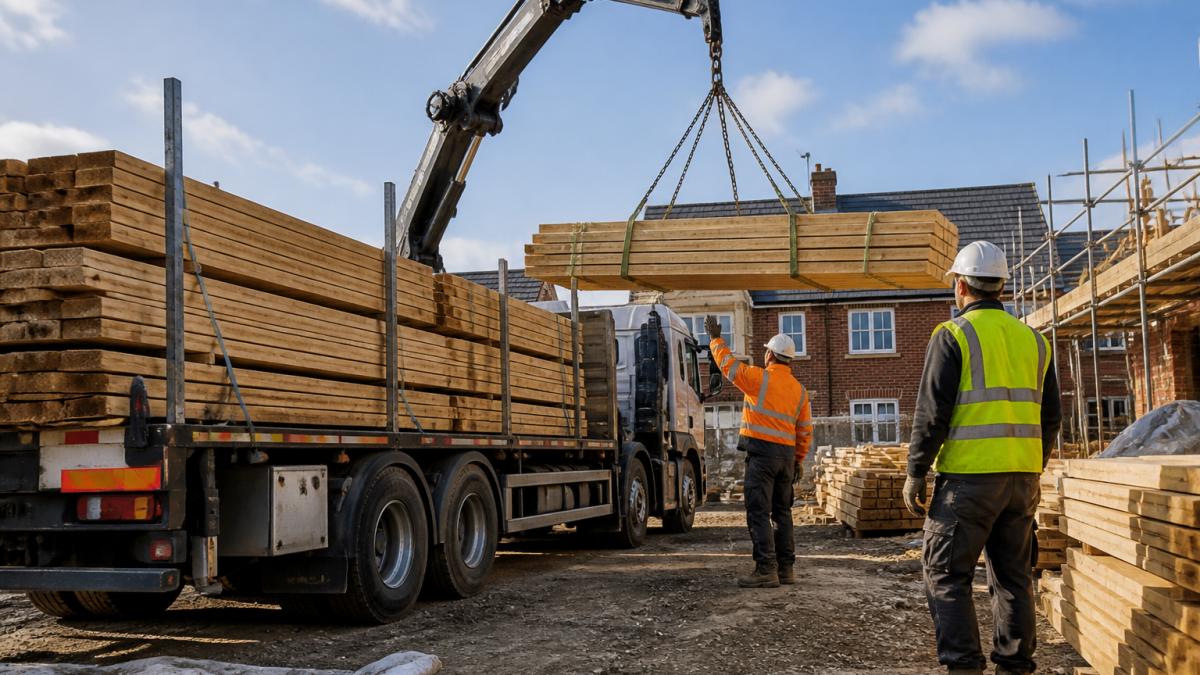
Some suppliers offer crane or hoist delivery for sites without ground-level access. This specialist service costs considerably more but may be necessary for upper-floor deliveries or sites with building restrictions.
Before ordering, assess your site honestly. Measure driveway width and check for overhead obstacles like power lines or tree branches. Confirm the ground can support a loaded truck (typically 10-15 tonnes per axle). If access is questionable, request a pre-delivery site inspection from your supplier. This costs nothing and prevents costly surprises on delivery day.
How to save on bulk timber orders
Saving on bulk timber orders requires strategic ordering and supplier selection. Several practical approaches reduce your total delivery costs.
Consolidate orders whenever possible. Ordering timber for multiple projects in one shipment spreads delivery costs across more materials. If you manage multiple sites, coordinating deliveries can yield significant savings. Larger orders qualify for better per-unit pricing and lower delivery surcharges.
Timing matters. Off-season ordering (winter months in many regions) often brings lower delivery rates because demand is lighter. If your project timeline permits, waiting for quieter periods can reduce costs substantially.
Choose flexible delivery windows. Specifying "any weekday between 8am and 5pm" costs less than requesting a fixed two-hour slot. Suppliers reward flexibility with discounts because it optimises their routing and scheduling.
Consider pickup options if you have transport capacity. Some suppliers offer discounts for customers who collect orders directly from their warehouses. For large orders, the savings can offset fuel and labour costs.
Compare suppliers genuinely. Delivery pricing varies significantly between providers. Trade Warehouse Direct's nationwide warehouse network means some customers benefit from shorter delivery distances. Request quotes from multiple suppliers using identical order specifications to benchmark pricing fairly.
Comparing delivery options and timeframes
Different delivery options suit different project needs and budgets. Understanding the trade-offs helps you choose the right approach.
Standard delivery uses scheduled articulated trucks serving multiple customers on a fixed route. Timeframes typically run 5-10 business days from order placement. This option suits projects where timing is flexible and cost is the priority. It's the most economical choice for most bulk orders.
Express delivery prioritises speed, often delivering within 2-3 business days. This costs more, sometimes 30-50% premium, but suits urgent projects or time-sensitive builds. Express delivery makes sense when project delays cost more than the extra transport expense.
Scheduled delivery lets you nominate a specific date within a wider window. This middle-ground option costs slightly more than standard delivery but less than express. It suits projects where you need certainty around delivery timing but can work within a few-day window.
Staged delivery splits large orders across multiple shipments. This option helps when storage space is limited or when you need materials arriving as different project phases progress. Staged delivery typically costs more per unit because each shipment incurs separate handling, but it reduces on-site congestion and storage requirements.
| Delivery Option | Typical Timeframe | Cost Relative to Standard | Best For |
|---|---|---|---|
| Standard | 5-10 business days | Baseline | Budget-conscious, flexible timelines |
| Express | 2-3 business days | +30-50% | Urgent projects, time-sensitive work |
| Scheduled | 3-7 business days | +10-20% | Projects needing delivery certainty |
| Staged | Variable (multiple shipments) | +15-25% | Limited storage, phased projects |
When comparing options, factor in project costs beyond delivery. A slightly higher delivery cost for faster arrival might prevent expensive project delays or labour idle time. Calculate the true project impact, not just the transport line item.
Trade Warehouse Direct offers all these delivery options, with pricing that reflects the logistics involved. Their nationwide warehouse presence in Victoria and Western Australia means some customers achieve faster delivery at lower cost.
Choosing the right delivery option for your bulk timber order requires balancing cost, timing, and site-specific factors. The cost of delivery for bulk timber orders isn't fixed, it responds to how you order, when you order, and how accessible your site is. By understanding what drives these costs and planning accordingly, you can reduce expenses without compromising project timelines.
Trade Warehouse Direct simplifies this process with transparent delivery pricing and flexible options that suit different project needs. Whether you're a sole trader managing multiple sites or a homeowner tackling a single renovation, understanding delivery costs upfront helps you budget accurately and avoid surprises. Get a quote today and see how delivery costs fit your project budget.
Frequently Asked Questions
How is the cost of bulk timber delivery calculated?
Bulk timber delivery costs depend on several factors: the total weight or volume of your order, the distance from the warehouse to your location, and the type of delivery service you select. Some suppliers charge by the mile, others by the load size, and some use a combination. Access to your site, whether it's kerbside or requires offloading equipment, also affects the final price. Request a quote from Trade Warehouse Direct with your specific order details to get an accurate figure.
What affects the delivery cost of a timber order?
Distance, order weight, and site access are the primary cost drivers. Orders to regional areas typically cost more than metropolitan deliveries. Heavy timber orders may require multiple trips or specialist vehicles, increasing costs. If your site has limited access or requires a crane for unloading, expect additional charges. Weather conditions and seasonal demand can also influence pricing. Always provide complete site details when requesting a quote.
Can I reduce delivery costs when ordering timber in bulk?
Yes. Consolidate orders. Order during off-peak seasons when demand is lower. Choose kerbside delivery instead of on-site offloading if feasible. Combine multiple small orders into one larger delivery. Providing accurate access information upfront prevents costly delays or additional fees.
What information do I need to get an accurate timber delivery quote?
Provide your full delivery address, the total weight or volume of timber you're ordering, your preferred delivery date, and details about site access, whether it's a residential property, commercial site, or building under construction. Mention if you have equipment on-site for unloading or if the driver will need to arrange that. Include any access restrictions like narrow driveways or limited parking. The more detail you provide, the more accurate your quote will be.
